Satellite Subsystems
This course provides hands-on experience with the process of designing and building a satellite mission following a compressed version of an standard space mission development process
Course Overview
The Satellite Subsystems module is part of the MSc Space Science & Technology course in UCD, in which students are tasked with designing and building a small scientific payload called a “Tuppersat” (as it must fit within a small Tupperware container) to be flown on a high-altitude balloon. Students will:
- Propose an interesting scientific experiment
- Apply Space Systems Engineering thinking to the design, development, and operation of a complex product
- Accomplish end-to-end system development
- Write formal documentation and project reviews according to ECSS standards
We provide laboratory workshops to teach the fundamentals of interfacing with microcontrollers and sensors, which is accomplished with MicroPython on a Raspberry Pi Pico. (Although, under special circumstances we can allow a Pi Zero instead.)
TupperSat Requirements
There are two primary requirements placed on each mission:
- Mission requirements, which answer what the mission needs to do in order to address their overall mission objectives
- Technical requirements, which answer how the mission will fulfill its requirements and objectives
During the Design/Review stage students learn how to properly identify, address, and meet these requirements.
Design & Review
The start of the term is primarily dedicated to teaching the principles of Design Thinking and its application to Systems Engineering. Students are responsible throughout the semester for periodic submission of data packs, which provide formal documentation and design information for their projects. The three primary project documents are the Preliminary Design Review, Critical Design Review, and Flight Acceptance Review, which represent a compressed version of the ECSS documentation process that encompasses all the necessary phases from science pitch to satellite deployment.
Assembly & Verification
As each group is given a €100 budget, we assist with sourcing all the parts they need for their mission, and offer guidance when necessary (which can be often!) during their hardware and software development stages. This includes fairly rigorous testing (guided by “lessons learned” from past TupperSats and the EIRSAT-1 mission) to demonstrate the robustness of their overall system in order to satisfy the Critical Design Review. Final verifications and testing plans are presented in their Flight Acceptance Review, which gives us – the launch operators – all the information we need to successfully assemble and deploy their TupperSats on launch day. (This was especially important during COVID, as launch was handled entirely without students!)
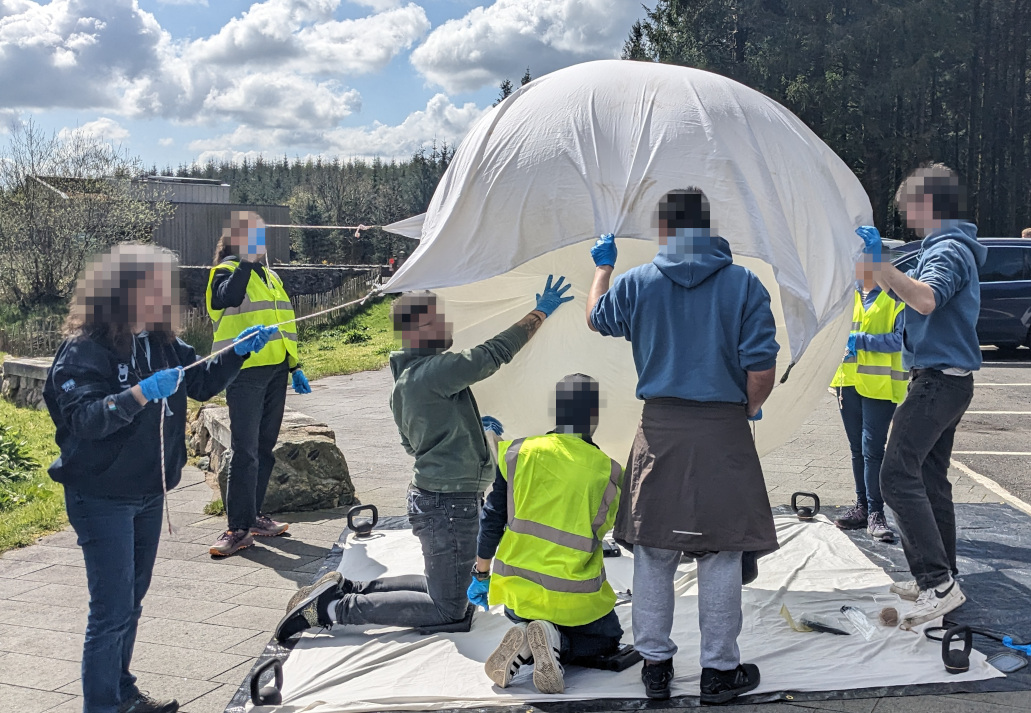
Flight!