Space Detector Lab
This course introduces a variety of detectors and instruments with a focus on their use in space science applications
Course Overview
The Space Detector Laboratory module is part of the MSc Space Science & Technology course in UCD. It is a lab-based module intended to instill a working, functional understanding of detector systems and image technology, and a provide practical experience with nanosatellite systems.
Topics Covered
The module has four primary components:
- Fundamentals of Python
- Optical Detectors
- High-Energy Detectors
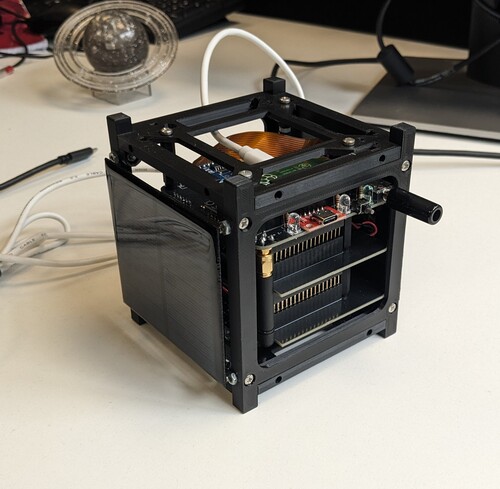
- CubeSats & Nanosatellite Systems
Coding Workshops
We provide an introductory-level Python crash-course for students which is primarily aimed at teaching coding logic and etiquette. As the skills learned in this module set a foundation for the rest of the SS&T course, we place emphasis on good coding practices and version control with Git. Students are given experience with virtual environment managers like conda and venv, and guided in the use of interactive platforms like Jupyter and VSCode/VSCodium.
Optical detectors
The second part of the module introduces students to CCD technology in the use of optical detectors for both space-focused and Earth-focused scenarios. This is accomplished through a series of workshops which guide them through analyzing data from the Hubble Space Telescope and Sentinel-2.
High-Energy Detectors
Students are introduced to x-ray and gamma-ray detectors in the third portion of the module. We provide four high-energy detectors (two solid-state and two scintillator-type) and access to radioactive sources, and task them with calibrating and characterizing each of the detectors. The ultimate goal is to discuss the suitability of each type of detector for different space missions. The experiments are designed to follow the pre-flight tests performed on the Fermi Gamma-ray Space Telescope, which are documented in Bissaldi et al. (2009).
CubeSats & NanoSats
In the final portion of the module, students get the chance to work with a type of nanosatellite called a CubeSat. For this we have utilized a CubeSat simulator developed by AMSAT, and the students perform a number of experiments aimed at exploring satellite subsystem architecture and remote access and communication.